Showing posts with label Nature Education. Show all posts

Saturday, September 5, 2020

Math and Loose Parts in Nature


From observing and leading natural loose parts play, facilitating workshops on math and loose parts in nature, and using mathematical tools outside, I have gathered a few key concepts for exploring math outside.

·     The world is alive with mathematical learning opportunities. Nature is full of patterns, cycles, shapes, and numeric opportunities. Take a walk outside with a mathematical lens to discover possibilities. Observe how children naturally experiment with mathematical concepts as part of outdoor play. Nature Notes, an observation sheet from Dimensions Education/Nature Explore, helps me and other educators notice counting (as children gathered 1, 2, 3, 4 sticks), matching of elements (leaves that were the same), application of geometric shapes (creating rectangles for a house), sequencing (working through the order of the tasks they planned out), symmetry, and understanding perimeter. Nature provides many non-standard examples to deal with complexities.


·     Nature can provide!While I love loads of manufactured loose parts, nature often has plenty of sticks, rocks, seeds, and pinecones. If not, they can be gathered locally for free. As children collect their own natural treasures, student choice and voice becomes prominent in their play and learning as they create squares, patterns, and solve challenges.

·     Bring the tools outside. We often hide away our math tools and manipulatives in closets, only using them when teaching a specific concept. Let’s take them outside so tools can be another “variable” in students’ play. 

o  Make grab and go kits. Having “starts” for the week in small backpacks make it easy to get math options outside as part of play. 

o  Create a math cart. Curate a larger collection of basic math supplies in an outdoor cart to make easy to transport to nearby nature areas. 

o  Use digital tools to support play. Depending on the technology you use and have available, digital devices have cameras to document and record information, timers, stop watches, tally apps, and other basic math tools. 

o  Consider mathematical tools to extend play.

§ Number and Operations—arrays, number lines, dominoes, yard dice, calendar numbers, sticks, milk or applesauce lids, ten frame, dice, fabric 100s chart

·     Arrays may include egg cartons, ice cube trays, muffin tins, tic tac toe or checker boards, sorting trays, and other sets organized in rows and columns.  

§ Geometry and Spatial Sensing—frames, 2D and 3D shapes (both found and from a set), attribute blocks, mirrors

§ Measurement—rulers, yardsticks, ribbons, yarn, rope, measuring tapes, sand timers, digital timers, scales, trundle wheel, balances, sticks and ropes in standards sizes (feet, two feet, yard, six feet for COVID)

§ Patterns and Algebraic Reasoning—pattern blocks, game pieces 

§ Displaying and Analyzing Data—garden lattice, tally sheets

§ General Items—chalk, wooden planks, milk crates, light colored fabric squares, recyclables, sticks, rocks, acorns, sweet gum balls, driftwood, pine needles, mark making tools and paper

·     Solve real life problems.Nicholson, the landscape architect who coined the term “loose parts,” explained in his theory that loose parts and learning should help solve real life problems pertinent to the students. The 4 questions of data analysis are a perfect way to support inquiry and emergent learning. As student start wondering about something, we can support and guide them through this process.

o  What do you want to know?

o  How can you find out?

o  What tools will help you collect the data? 

o  How will you use the information? (from Messy Maths)


As educators, we can help support and extend mathematical learning in our emergent curriculum as we follow students’ questions, use mathematical vocabulary, observe and anticipate mathematical supply needs, assess learning, and allow children plenty of nature play. In our research, my colleagues and I found the role of facilitator in loose parts to be: 

Loose parts are open-ended, interactive, natural and manufactured materials that can be manipulated with limitless possibilities. Interaction with loose parts includes experimentation, exploration, and playful interactions with variables through creativity and imagination. Participations have the freedom to explore variables, combine materials, and react to complex themes and ideas that emerge. Facilitators encourage participants make loose parts available, stimulate discovery, provide opportunities, allow for open-ended play, and prompt meaningful connections and experiences. Through loose parts exploration participants develop imagination, creativity, and collaborative skills. Process is more important than the end product fostering overall growth and development. (Gull et al., 2019, p. 51)

You’re ready to see and support natural mathematics exploration in play! 


Resources to Help


Math Resources and Tools on Amazon (including book suggestions!)

Mirrors for Mirror Books


Resources from Juliet Robertson:

Suggested materials for maths outdoor—good list of basics to consider

Messy Maths Handout--Great content! 

Sammy the Metre Snake—consider a yard snake in the US


Books from Juliet Robertson:

Messy Maths—great book that goes through all mathematical domains

Dirty Teaching—general information about learning outdoors

---

General suggestions for outdoor maths from NAEYC—good suggestions to consider! 


Math Vocabulary—terms to consider to use

Kindergarten math vocabulary with definitions


Nature Notes-- Documentation Option, p. 62-63


Conference Presentation on Early Maths—inside focused--vocabulary, activities, potential sequencing lists, etc.


Big and Small Outdoor Action Card Prompts—action prompts to explore big and small


Gull, C., Bogunovich, J., Goldstein, S. L., & Rosengarten, T. (2019). Definitions of Loose Parts in Early Childhood Outdoor Classrooms: A Scoping Review. International Journal of Early Childhood Environmental Education6(3), 37-52.https://naturalstart.org/sites/default/files/journal/6._gull_et_al._formatted_draft_v2.pdf


Saturday, December 24, 2016

Board Games with a Nature Twist

While we love getting outside, we also enjoy playing games together! We have found a few nature related board games we enjoy!

1. Bingo! Wildlife Bingo is a classic game that can be played by just about any age. These games are pretty basic, with paper counters, 6 bingo cards and cards for all the animals. The animal cards have information on the back. I even learned a few things when I read these, such as mink being excellent swimmers. My kids started making connections between different animals with the deer family and also with members of the rodent family. I find the number of bingo cards limiting, as I'd most likely want to use this in a larger group, however, it works fine for my family. It is made of thin cardboard. It also includes animals from all of North America, rather than just our region. There are numerous other nature bingo topics, like birds, insects, nature, wildflowers, and freshwater fish. These could be made with your own pictures as well to make them more customized.


2. Professor Noggin series! The Professor Noggin series of games includes simple games that test your knowledge. There are two levels of play (can be different for each person playing), making it good for adults (or older kids) and kids to play together. Once again, not region specific, but we've learned about animals while playing the game. It would be another good one to make your own clues. It also has many topics--Freshwater Life, Reptiles and Amphibians, Birds, Insects, etc. I like the portability of these, too.

3. Sneaky Snacky Squirrel! We have really liked this game. The box is shaped like a tree with plastic acorns inside with a set of tweezers shaped like a squirrel. While it doesn't directly teach about squirrels, it reinforces color and counting with younger children. I found all of my boys would play it together (aged 2-10 when we first got it). See my full review here.  While it doesn't talk about squirrels, I find we have plenty of conversations about squirrels while playing. I gifted it this year and bought an extra to have for upcoming birthday parties for my 4-year-old.

4. Animal Tracks! This game can be played as Bingo, matching, or guess the tracks. The game is fine, but includes animals from farms and all over, rather than a specific place. Can you tell I like learning about animals in our region as a solid foundation for our kids? Sometimes, I will separate the cards into sets that make more sense of them to be together.

5. Hide & Seek! A friend brought this over for Christmas this week. It's really similar to playing hide and seek in the yard! I liked that there was a stream, four-leaf clovers, and other details we might find outside. My friend's family had made/played this game for years and then her son got them interested in producing it for market. We had fun playing it--we should follow it up with a real game of hide and seek! It was fun trying to stay away from each other.


6. Wildcraft! An Herbal Adventure Game. We purchased this as an early Christmas game. It was simple to play, though took just playing the game to understand how to use all the cards. The artwork is great! The cards reinforced various plants we might find in the wild (though many transported by colonists) and how they might help various ailments. The game is cooperative in nature, which was kind of nice. I like competition, too, but enjoy working together, too. You can download a story to read as you go on the adventure. We're looking forward to playing this more! It does not go into depth about the plants, so I might put a field guide on the table while we are playing. We noticed the distinctions between the plants. This is a fun way to start thinking about plants more.


7. Nature Fluxx! We played this with my brother and sister-in-law. They always find good games. I would say older kids or adults would want to play this more. The premise of the game is pretty simple, but due to the changing nature of the game, it is always a challenge and fun to play. There are other games in the Fluxx line, though we appreciated the natural spin on this on.

8. Settlers of Catan I feel like I need to include this as it deals with humans' interactions with resources. It reminds me subtly that our resources are finite and how much we depend on them to build and expand. We need to be responsible stewards. There is no clear nature connection beyond that; however, we enjoy the strategy of playing this game.

9. GoFind It! This is a neat card based seek and find game for outside on the trail. It is handy to have in a trail bag to bring out when kids need a pick me up. Match different characteristic cards to find unique items in any spot in nature!


What nature inspired games have you enjoyed? Want to play? Just let us know! We'd love to have you over if you are local.

I have been able to find some of these at yard sales or thrift stores, making them less expensive. I watched the Wildcraft game for a couple of years before taking the plunge to buy it. I waited until I found a good sale. It's also fun to get together with other families or couples with each bringing a nature game to play! Locally, Better World Books in Goshen also has many games on display as demo games, as well as a game night. This can be a great place to try out a new game.

This post may contain affiliate links. Check out some of the other games below:


Tuesday, November 4, 2014

Let the Outside In!


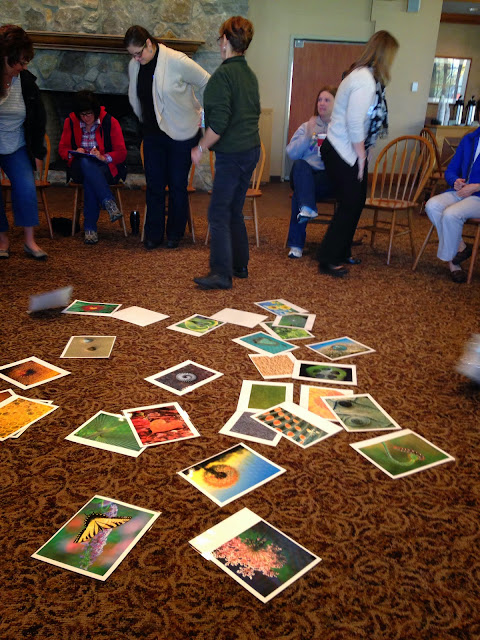
I went to a workshop down at Conner Prairie on bringing nature inside the classroom. Conner Prairie was generous to make this available to educators! The setting was right, with large open windows overlooking the trees and the facility. There were natural items on the tables. Heather Mead, Director of Education, came from Heritage Museums and Gardens to lead the workshop. What an interesting place! It sounds like they are doing great nature education there! I'm excited to see what else Conner Prairie is doing as they have some great natural spaces and developing nature play spaces as well. 

To introduce ourselves, we found nature pictures we could relate to for some reason and shared with the group. These were beautiful pictures of shapes, patterns, colors, and items from nature. They bring back memories and encouraged me to get outside and discover the magic of nature once again. It was a great collection that I'd love to have. I'll need to start collecting. 

Thursday, May 22, 2014

Certified Interpretive Guide Training

This last week I attended Certified Interpretive Guide (CIG) Training through the Indiana Department of Natural Resources at McCormick's Creek State Park. The state gathers new and returning seasonal naturalists for 4 days of training each year, with the add on bonus option of CIG certification through the National Association of Interpretation. Beyond the state park naturalists, many Indiana Master Naturalists who are involved as volunteers and in paid positions around the state were involved in the training.


During our first afternoon, there were several stations set up to explore various principles of Tilden. As I tried to wrap my mind around Tilden's principles, these key words stood out: RELATE, REVELATION, ART, PROVOCATION, WHOLE, and CHILDREN. Tildren's Principles of Interpretation are the basic building blocks of the interpretation field. To understand these principles more, we visited stations focused on having a unique approach with children that is more interactive and playful while learning about butterflies by Jessica Rosier from Mounds State Park. We were provoked about deer and the management through stories by Marjorie Hershman from Pokagon State Park. We've enjoyed programs and interacting with her at the Nature Center there. Others related the principles through cattails, making butter, and more.


Sunday, March 23, 2014

Growing Up Wild

I'd been looking forward to this Growing Up Wild training for several months. I know the book is highly sought after and is included in the $20 fee. If you can find it, it usually costs more outside of the workshop. In addition to the curriculum guide, it also was good to swap ideas and experience some of the activities in the guide.

I am excited to have this resource. It is centered on 27 nature based lessons for children ages 3-7. It includes the rationale of connecting to nature, developmentally appropriate practices, nature play, nature in the classroom, math connections, language and literacy connections, and healthy kids sections to approach these activities with a comprehensive mindset. It talks of sparking creativity, scientific inquiry, assessing children's learning, respect for living things, responsible collecting, and safety. 

Each activity shares standards and correlations, resources, quick facts, vocabulary building, materials and prep, warm up activities, tips for excellence in early childhood education, activities to take outside, health activities, helping hands to help build on appropriate respect for living things, math connections, take home activities, art projects, music and movement, extension activities, and an snack idea. It's nice to have this all in one place! While the book is oversized and rather large, the suggestion to put it on top of the books on the bookshelf was helpful. It includes many additional resources, such as an index, children's book list, educator resources, federal agencies, organizations and programs, and a list of where to purchase materials. Here is a sample activity on fishing fun. Many of the copy pages are available here, which makes it much easier to print as the books is rather bulky. I also had found this wildlife correlation to holidays previously on the Internet, yet didn't realize it was part of Growing Up Wild. The website for Growing Up Wild has a wealth of other resources if you keep poking around. It is part of Project Wild. 

Saturday, February 8, 2014

Camp Eberhart: Winter Ecology

Earlier this week, I was able to bring my niece and nephew to their first session of their Outdoorsmanship Class at Camp Eberhart, which is a YMCA camp in Three Rivers, Michigan.


Of course, the drive was snowing, but it was accessible. 


Sam conducted the course. He recently graduated from college and has lots of enthusiasm to share with the children. As an ice breaker, he had the children play the toilet paper game, where each person grabs as much toilet paper as he/she thinks they will "need" and then shares what one fact about them for each piece of toilet paper. I've done this lots of times in classes and with groups to help get to know each other. I like how he simply helped the children share the expectations and guiding values that permeate the concept of the YMCA: caring, respect, honesty, and responsibility. 


Sam used a flashlight and a styrofoam ball on a stick to show how the earth turns away from the sun during the winter so we have colder temperatures. This was a good illustration to see what was happening on a larger scale.


Later we went outside and the kids experimented with the snow a bit. It was a cold day and there was little moisture in the air. It was hard to make a snowball; however, when Sam added water to the mix, they were able to pack it. I've heard Inuit have many, many words for snow. We have to add lots of modifiers to describe the snow we have in English. 


Of course, they had to throw the snowballs at their fearless leader. 


We walked around the camp, checking out the horses in the field, the tubing hill, ropes course, and water features. It looks like it would be a fun place to stay! 


I liked seeing the remnants of various shelters around.


The lake was covered with snow, but I see great potential for fun in the summer. We could see animal trails through the snow.  


All the gear is stashed for canoeing and other summer fun.


Here, we could see what Sam was calling a tree well, a sheltered hole or place where animals can take shelter in extreme weather. They had fun trying to figure out what was in there!


They also talked about how some plants (like pines) are still green, mentioning these leaflets are covered with a wax to protect them. We checked it out up close!


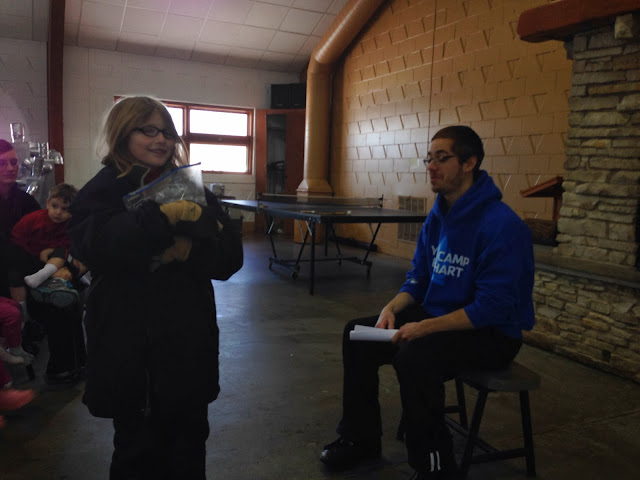
Back inside, we looked at the various adaptations animals have to survive the winter. Each adaptation had something for my niece to put on to help keep her toasty! For example, for the beaver, she had a raincoat. These helped the children visualize the elements. 


Looking around the building, I saw the neat activities and programs they have available--these look like fun! 


Later, they made cut snowflakes and had a snack of hot chocolate and homemade granola. 


They spent time playing king of the mountain outside and climbing on big snow piles! 


I love the girl power! The kids will continue their course throughout the semester. I look forward to joining them again! There are also summer camps for kids, day camps, and even family camps. I think the family camps would be fun to try as they have so many amenities.