Showing posts sorted by relevance for query indiana master naturalist. Sort by date Show all posts

Thursday, June 13, 2013

Indiana Master Naturalist Program


We have a GUEST POST today by Monica Yoder. Each week during my Indiana Master Naturalist training, she was there helping our class, being an example, and mentoring us as we went through the learning process. I started Inside Outside Michiana shortly after I finished my training, wishing all these cool nature events were on one calendar, rather than scouring 8-10 (now more!) newsletters and other online sources for neat programs. I also wanted to give a voice to nature in the area and help others experience a bit of what I was learning in my classes. I've been helping with a Jr. Indiana Master Naturalist day camp all week (hence fewer posts) and I'm reminded of the power of this program to empower people to learn about nature in our community and to give back! Word on the street is that classes will start after Labor Day  and will be on Thursdays from 3:30 to 7:30pm at various locations around Elkhart County. The cost is about $175; however, I received a new book many weeks and now have a great reference library to go with my learning and volunteer service. They do not advertise this, yet I find this to be a great benefit to the program. Some might ask how to fit this in to a busy work schedule . . . some arranged with their bosses to come in early and leave work a little early for the classes. To be honest, attending this came down to scheduling--it basically worked on a time/day that I usually could have childcare. It was nice to have a little "me" time, dedicating time to learning more about something of interest. I really 
enjoyed meeting people and making friendships with others who had similar interests. 


Friday, November 15, 2013

Elkhart County Indiana Master Naturalist Potluck

Once a year, the Elkhart County Indiana Master Naturalist group gets together for a potluck, share hours, give aways, and just to enjoy each other's company. What is an Indiana Master Naturalist you ask? I know I share about this program all the time. Read more about it here.

We met at Rieth Interpretive Center in Goshen. There was plenty of delicious food. It's obvious that much of the food was local and homemade. I broke out the new after Halloween bird talon salad serving tongs for my salad! Nancy Brown from Elkhart County SWCD (Soil and Water Conservation District) is one of the group "hosts" that coordinates the groups. One family had their one year old with them who wandered up to the book table. She picked him right up and we were all reminded that we do all of this partially for this very reason--to help young people connect with nature and have a healthy planet! I know I find my volunteer work most fulfilling when I get to work with others to provide good quality nature based experiences in many forms.


Nancy always has a large stash of books! She had several to give away. She's been collecting our volunteer hours and had book giveaways to everyone who had turned in their hours so far this year. There were all kinds of books from previous classes, her stash, and another person who recently moved away and had books to share.


As she announced our nature service hours, she let us come up and pick a book. I had a lot of volunteer hours this year (lets try over 500) so I got to pick first. I was having a hard time deciding, so she just let me have the two I was mulling over. I have been doing most of my volunteer work at Woodlawn Nature Center in Elkhart, but also helped with a Junior Indiana Master Naturalist summer camp and then help with the Indiana Master Naturalist Facebook page. 


One of the IMNs also made some lovely walking sticks to give away as well. :-) I was fortunate to win one of those, too. While it was great to take home a few prizes, I mostly enjoyed meeting with some friends, catching up, sharing our nature experiences, and dining on good food. I am very impressed with all the service these people give back to the natural community! They volunteer at Gene Stratton Porter's Historic Site, Maplewood Nature Center, Middlebury Parks and Recreation, Goshen Parks and Recreation, Elkhart County Parks, Woodlawn Nature Center, SWCD, Wellfield Botanic Gardens, Elkhart Environmental Center, and more! They are a delight to know and call friends. 

Tuesday, December 10, 2013

Indiana Master Naturalists


Day 9: Indiana Master Naturalists

I have loved being involved with Indiana Master Naturalists! I started with a class last fall, meeting with others once a week for about 3 hours to learn about the natural resources in our area. We met with professionals all over Elkhart County. As part of the class, I received numerous resource books on nature pertinent to our area. The value of the books easily absorbed the cost of the class. People who help with the class area also volunteers, mainly being run by SWCD and Elkhart County Parks. We finished the class with an open note and open book quiz to test our knowledge and effectiveness of the classes. After the course, we are expected to do as many hours of volunteer work as we had in class or 30 hours to maintain an active status. It's a great way to learn and serve and help connect others to nature! I see IMN volunteers at various nature activities. I know they make an impact.

There have also been groups in St. Joseph County in 2012 and at Gene Stratton-Porter's State Historic Site in 2013. Updated schedules can be found at the state Indiana Master Naturalist page.


After the class, I've enjoyed volunteering at various nature-related activities in the area and meeting with other IMN graduates on a quarterly basis. It's fun to touch base, share stories and find others with similar interests. Often, there is a guest speaker, there are often snacks, and we spend a little time socializing as well.

I've written about Indiana Master Naturalists before today. I also really enjoyed the IMN state gathering near Prophetstown State Park this fall. In 2014, it will be held in Elkhart County--nice and close to home!

IMN Potluck

Guest Post by Monica Yoder about Indiana Master Naturalists

IMN Fall Potlucks 2012

Sunday, July 26, 2015

Creating a Nature Library


Creating a Nature Library

Dr. Seuss once said, “Fill your house with stacks of BOOKS, in all the crannies and all the nooks.” While we might not need to fill all the nooks and crannies, having access to great nature books enhances our nature study. Here are several ways to add to a home nature library.

Use the library to preview books. The library is a great place to check out books for the first time. Once I realize I check a book out many times, I usually buy the book to have as part of our nature library.

Join a book club. I organize a monthly nature book group at our local nature center. Each month I get a new book to read and add it to our nature library. If it’s not a “keeper”, I can sell it back or pass it along to someone else who might like it.

Find favorite authors. I love nature books for preschoolers by April Pulley-Sayre and Denise Fleming. I always check out new books by these authors. April’s most recent book, Woodpecker Wham! certainly delivered!

Sunday, August 19, 2012

Middlebury Riverfest

We had a blast at the Middlebury Riverfest at Riverbend Park! We went geocaching here before but haven't spent as much time in the area. I liked the park--there is a nice blend of recreation and hiking trails. There is also a river running through it which is a nice feature.

I've loved watching Daragh Deegan's presentations on fish. I've seen him with his tanks of fish at the YMCA kids day, cub scout day camp, etc. This was the first time that I knew about where we could actually see him using his fish shocker to collect specimens. He is the Aquatic Biologist of Elkhart County and uses fish samplings to assess the water quality in the area. I also was able to participate in his demonstrations as part of Indiana Master Naturalists. Good info and fascinating to learn about these fish. My son remembered the lampreys! I think he also put up a small exhibit at Woodlawn Nature Center. While there were other great activities, seeing this advertised was the hook that sealed the deal as we made plans for the weekend.

The kids loved the children's activities area. It was very hands on and the candy for prizes didn't hurt their interest and motivation level. I enjoyed going to the different booths to learn about natural resources in the area and connecting with others who enjoy the outdoors. We really have great resources in the area! 

Notice the little guy in the sling--that's our newborn! He was 9 days old and went on his first longer hike with an Indiana Master Naturalist in the woods. It wasn't his first time out. I started going stir crazy the first week home and ran over to Bonneyville Mill for a nature fix. The dahlia garden was beautiful that day. 
 The kids made boats out of natural materials and then later sailed them on the river. They didn't go too far. A testing pool might have helped beforehand, but it was still exciting to see the kids involved and the boats setting out on their journey!


It's kind of hard to see in this picture, but there is a clump of branches high up in the tree. The festival arranged buses to take us to a nearby Great Blue Heron Rookery, led by a local scientist who did his master's thesis on Great Blue Heron rookeries in Indiana. I didn't know this was available during the festival. I've since listened to him again--fascinating! I saw several Indiana Master Naturalists helping out throughout the day and countless others--thanks for the great experience!


Can't wait until next year! There was a little of something for everyone! Like it on Facebook!

Sunday, March 23, 2014

Growing Up Wild

I'd been looking forward to this Growing Up Wild training for several months. I know the book is highly sought after and is included in the $20 fee. If you can find it, it usually costs more outside of the workshop. In addition to the curriculum guide, it also was good to swap ideas and experience some of the activities in the guide.

I am excited to have this resource. It is centered on 27 nature based lessons for children ages 3-7. It includes the rationale of connecting to nature, developmentally appropriate practices, nature play, nature in the classroom, math connections, language and literacy connections, and healthy kids sections to approach these activities with a comprehensive mindset. It talks of sparking creativity, scientific inquiry, assessing children's learning, respect for living things, responsible collecting, and safety. 

Each activity shares standards and correlations, resources, quick facts, vocabulary building, materials and prep, warm up activities, tips for excellence in early childhood education, activities to take outside, health activities, helping hands to help build on appropriate respect for living things, math connections, take home activities, art projects, music and movement, extension activities, and an snack idea. It's nice to have this all in one place! While the book is oversized and rather large, the suggestion to put it on top of the books on the bookshelf was helpful. It includes many additional resources, such as an index, children's book list, educator resources, federal agencies, organizations and programs, and a list of where to purchase materials. Here is a sample activity on fishing fun. Many of the copy pages are available here, which makes it much easier to print as the books is rather bulky. I also had found this wildlife correlation to holidays previously on the Internet, yet didn't realize it was part of Growing Up Wild. The website for Growing Up Wild has a wealth of other resources if you keep poking around. It is part of Project Wild. 

Wednesday, February 4, 2015

Lilly Nature Center

We were in West Lafayette the other weekend and stopped by Lilly Nature Center that is part of the Celery Bog Nature Area. As we drove up, it was great to see so many people out using the property, whether they were hiking, jogging, cycling, birding, etc. I love seeing natural spots in the middle of busy life! This is about 195 acres of wetlands, woods, and fields. The small interpretive center also hosts a room for rent for conferences and meeting space.

As we entered the nature center, we were greeted by barefoot children sitting on a log watching a turtle.  What a great way to set the stage for exploring nature! Inside we checked out the wildlife viewing window first. Sound is piped in from outside over speakers so we could hear all the birds outside. The feeders were plentiful and well stocked. We talked about the many birds outside, like the juncos, cardinals, etc.


The lobby has many windows open to the natural world, helping us feel at home in nature. There were a few interactive components that helped us learn more about frogs and other animals. My youngest loved being next to a frog his size! 

Tuesday, April 2, 2013

Woodcock Watch

bird book public domain free image woodcock
Source        
I first met Elma at an Indiana Master Naturalist meeting through a mutual friend. She is meticulous in her details and takes copious notes. She saw me a couple of months later at the First Day Hike and remembered me. Later, she took my family on a hike in HER stomping grounds. She has a good heart and is a good writer. She joined us for our Nature Nook book group meetings at Woodlawn Nature Center. Thanks for sharing, Elma! By the way, Elkhart County Parks recently did a Woodcock walk near our house--I need to find them! I tried the other day, but with all 4 boys it was a lost cause with our noise factor. 

Here are a few resources:
How to find a woodcock video--They arrive a little earlier in our area.
A family's description of a woodcock walk--The site includes a description of the woodcock from Aldo Leopold's A Sand County Almanac
All About Birds' woodcock entry


Nature's Best by Elma Chapman, Indiana Master Naturalist
Woodcock Watch.  The warmer weather at the end of last week was welcomed by all.  While hiking at Pine Knob I heard two kinds of frogs, the spring peeper and the midland chorus frog.  I also saw some skunk cabbage breaking through the surface soil.  The bird chatter is increasing as are the species heading north.  In my yard this week I have seen bluebirds, grackles, redwing blackbirds, robins, goldfinches, sparrows, mourning doves, cardinals and blue jays.  The juncos and redpolls that have been at my feeder most of the winter haven’t headed north yet, but they’ll disappear any day now. I have seen wild turkey, hawks, vultures, phoebes and killdeer in the county this week.  Not all of these birds migrate, but it’s nice to see so many different ones again.  And most exciting of all for me is that there was a loon sighted on Sylvan Lake on Saturday.  Loons are fascinating birds and unfortunately they don’t stay with us, but we do get to host them on our lakes for a short time in the spring as they head north from the Gulf Coast.
A bird I have never seen, but hope to this week, is the American woodcock.  They are very well camouflaged in a mottled brown to match the leaf litter on the forest floor where they forage for worms.  They live year round in the southeast United States, but expand their range as far as southeastern Canada in the summer.  So why do I hope to see one this week?  Because I plan on participating in the woodcock watch that the LaGrange County Parks is having this week.  Tuesday night they will be at Delt Church Park at 7:30 p.m. to look for the woodcocks.  Wednesday they will try to find some at Pine Knob, also at 7:30.  They have been seen in the past at Delt Church, but this will be a first to try to find them at Pine Knob.  The habitat is right, so there is a good chance we might see them both nights.
Last week the Parks Department had scheduled a frog census in the parks, but had to cancel it because it was just too cold.  The frogs are very temperature sensitive.  So I asked Scott Beam is the woodcock watch was likely to be canceled and his response was no, that woodcocks go by the calendar and not the temperature, and this week is the week to see them.
So what’s so special about a woodcock, and if they are so well camouflaged, how do I expect to see them?  The answer to both questions is that the males have a spectacular mating ritual that involves calling on the ground a sound called a “preent” and then flying up in a spiral to a height sometimes over 300 feet and then chirping while diving down in a zigzag to land silently next to a female and then do the whole thing over again, just to impress her. According to the Cornell Lab of Ornithology’s website, the male does not participate in parenting responsibilities and may do his preenting at several different singing grounds with several different females.  The female for her part may visit four or more singing grounds, even after she is caring for her young.  Sounds like these woodcocks are real party animals!
Woodcocks are not tiny birds:  their wingspan is between 16-18 inches and their length is 9-12 inches.  They have quite a long bill for poking around in the leaves and soil looking for earthworms and insects.  They nest on the ground in a shallow depression and may have 1-12 eggs, which are creamy buff with brown spots concentrated near the large end.

Friday, November 15, 2013

Acorns!

I had a great dinner tonight! It only cost $3, included an educational aspect, and highlighted the humble acorn! I remember our family roasting an acorn when I was 11 or 12. As I remember, it didn't taste so great. However, Andy, from Elkhart County Parks, made tasty treats for us!

He usually has a few hand outs to help us understand the topic better. I have several copies of this dichotomous tree chart from various programs by now. It really is handy to identify and classify the tress in our area. Andy talked about red and white oak families. He said the red oaks are especially bitter. These have stipules or pointy tips at the ends of each leaf section. These are also called bristle-tipped leaves. Red oaks include black, red, in, and shingle. The white oak acorns are a little less bitter and include bur, white, chestnut, cinquapin, and swamp white oak trees.


As far as using acorn, Andy shared how he prepared the acorns and several recipes. Here are several acorns which have been dehydrated after they were soaked (draining water each day) for several days. The tannins are leeched from the acorns through this process. You can see the color in the jar of liquid below. It was used to cure hides at different times.

When using acorns, discard the one with worms. Watch for any fungus that might be growing. Another option is to sprout the acorns first. I think this is a great approach as we have done sprouts of other kinds in the past with one son even using them for his science fair project last year.


This is what the acorns looked like when they were ready to process after several days of removing the tannins with cold water. Andy used a food processor to grind break them up into smaller pieces. 


He then roasted them in an electric skillet to enhance the nutty flavor. They didn't have too much flavor, though added a lovely texture and crunch to the foods we ate. He added them to a mushroom soup for one of the dishes. 


We also tried them roasted with a little salt. I might need a little more salt. :-)


This is a my plate, with several acorn treats. We had acorn mushroom soup, peanut butter acorn cookies, an acorn dip, and acorn banana bread. They were all very good! 


To top off the night, we made acorns with small vanilla wafers, chocolate chips, hershey kisses, and frosting. I've seen these floating around Pinterest--it was fun and tasty to make them myself. 


Andy mentioned that Native Americans ate acorns by "the ton". The acorns were often broken open, placed in a basket, and dropped in the river for several days to leech the tannins. The left over water with tannins would have been used to tan hides or as an antiseptic. He wrote an article in the current Currents (but it looks like you need to see the hard copy to find his article) that mentioned the Japanese collected a million tons to supplement their meager food in the mid 1900s. Acorns need a cold spell to germinate. Only 1 in 10,000 acorns actually become trees. They start producing acorns at around 20 years and stop producing around 80 years old. It's best to gather them just as they start falling, trying to take them off when they are still green on the tree. 1 oz. of acorns is 142 calories. They have been feed to pigs to fatten them up. I've also read that acorns that are "planted" (should say cached!) have a higher germination rate than acorns planted by humans. If they are planted by humans, they do need a cold spell (keep in the fridge in a plastic bag) in order to germinate, as do many seeds. In programs, I've done with preschoolers, I've also learned that bluejays have great beaks for cracking open acorns. There is an acorn woodpecker (does not live in this area) that actually hammers acorns into a tree to store them for later. 

It was nice seeing a few people, too. I saw a lady from the Flying Wild and Children, Art, & Nature program, two great teenagers who were part of the Junior Indiana Master Naturalist program this summer, and a couple of others I've seen at various festivals and such around the area. It was great to chat with others interested in similar things. I shared about the Indiana Master Naturalist program again and also shared the Eat Wild group with several. 


Tuesday, July 2, 2013

Gene Stratton-Porter State Historic Site

As part of the Nature Nook book group at Woodlawn Nature Center, I traveled to Gene Stratton-Porter's State Historic Site to meet friends for a tour and book discussion last week. Before, I pulled up, I saw a huge banner for their upcoming Indiana Master Naturalist class--that will be great! There are also other classes going on throughout the state.

Thursday, May 22, 2014

Certified Interpretive Guide Training

This last week I attended Certified Interpretive Guide (CIG) Training through the Indiana Department of Natural Resources at McCormick's Creek State Park. The state gathers new and returning seasonal naturalists for 4 days of training each year, with the add on bonus option of CIG certification through the National Association of Interpretation. Beyond the state park naturalists, many Indiana Master Naturalists who are involved as volunteers and in paid positions around the state were involved in the training.


During our first afternoon, there were several stations set up to explore various principles of Tilden. As I tried to wrap my mind around Tilden's principles, these key words stood out: RELATE, REVELATION, ART, PROVOCATION, WHOLE, and CHILDREN. Tildren's Principles of Interpretation are the basic building blocks of the interpretation field. To understand these principles more, we visited stations focused on having a unique approach with children that is more interactive and playful while learning about butterflies by Jessica Rosier from Mounds State Park. We were provoked about deer and the management through stories by Marjorie Hershman from Pokagon State Park. We've enjoyed programs and interacting with her at the Nature Center there. Others related the principles through cattails, making butter, and more.


Sunday, March 9, 2014

Michiana Master Gardeners Spring Celebration

I manned a booth at the Michiana Master Gardeners Spring Celebration this last weekend. There were various nature and gardening related booths set up outside the main presentation hall. People had time to chat, mingle, and check out the various topics and ideas. Sally Roth was the main speaker . . . read about her presentation at the end of the post.

Saturday, June 15, 2013

Primitive Skills at Woodlawn Nature Center

The Junior Indiana Master Naturalist group came to Woodlawn Nature Center to hear Erik Vosteen, a regional primitive skills expert. He started talking about archeology and how professionals learn how people lived in ancient times. He also touched on ethnography, which includes living with local ecosystems. A point he brought up often is that people's needs have always stayed the same over time. Resources are things we need to live.

Friday, November 16, 2012

Indiana Master Naturalists

I thoroughly enjoyed my classes with Indiana Master Naturalists. Tonight we took our tests and had a potluck/gathering with our classmates and instructors at Rieth Interpretive Center in Goshen.  As we reflected on our time together, several mentioned how the course brought together people with similar passions. I can't wait to spend more time with them serving and exploring our natural surroundings! Such neat people! Also, the instructors and steering committee did an excellent job of putting it all together for us.

We received several books as part of our class and needed to use a few as tools for our test. These four books are great basics for any naturalist household.

Thursday, July 25, 2013

Nature Nook Book Group

Last night we had another Nature Nook book group at Woodlawn Nature Center. Basically, we all read a predetermined book centered on nature in some way and get together and discuss it. We pull out the salient points, discuss how we might use the book, share additional resources, use study helps from the Nature Center, and enjoy talking to each other about the book. Reading the book is helpful; however, it is not necessary. We started the group as a few recent Indiana Master Naturalist graduates that wanted to keep meeting together and read the books we received as part of our training. It's a great program starting up again soon. Here is a local article about the IMN training. If you love nature and love reading, Nature Nook could be a perfect combination!


Wednesday, May 29, 2013

Nature Summer Day Camps Round Up

I've always enjoyed summer day camps. It's fun to get out, meet new people, and do something besides sitting glued to the television. I went to a few as a child, was a counselor for camps as a young adult, and now send my own older children to summer day camps! We're still trying to find the right ones that fit with our schedule. There are several great options in the area!

Elkhart County Parks--My son went to the Nature Explorer camp here last year. He enjoyed being outside each day and building huts! We like Ox Bow and enjoy classes with Miss Krista. This is for ages 7-9.

Saturday, January 4, 2014

Nature Inspiration Collage


Day 25: Nature Inspiration Collages

It's been a chilly few days (and getting colder next week!). The cousins were over and they did go outside for a while, but we also needed some inside activities that didn't include technology. I have stacks of magazines to repurpose and was thinking about the new year, so that we would make collages or vision boards for our nature plans for the upcoming year. 

The kids spent plenty of time going through the magazines and finding the pictures that spoke to them. I questioned some of the "connections", but maybe they were hoping to eat whoopie pies while staring at the stars! 


Pictures were carefully arranged and chosen. 


I needed to spread mine out on the pages, trying to fit in all the elements. 


My requirements were to fill up the space (still working on that!) and make a title. They also needed to write 3-5 nature or outdoors related goals on another piece of paper. We used their nature journals we started a couple of years ago. We need to use these more! 


I would say one child may end up a farmer. He wants to be more involved in our garden this year. Another one is thinking about lots of processed foods and having fun with his cousins! 


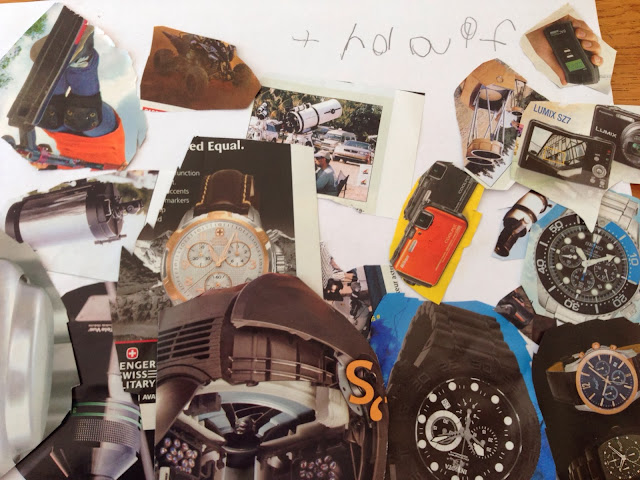
Our younger son seemed obsessed with watches and electronics. I think he didn't get through too many magazines! I can see him doing this over and over and over again based on his recent letter, envelope, and wrapping presents fixations. 


Mine did fill the space a little more, looking at nature, recreation, healthy eating, etc. I included found words and phrases as part of mine. I chose not to write down my goals, as the collage spoke for itself.


I loved reading the kids' goals! We're working on the snow fort tomorrow. :-) He's homeschooled and actually gets to take a Young Outdoorsman class this next semester at a nearby YMCA camp. I want to tag along! He also did the Junior Indiana Master Naturalist program this summer. We'll have to invite him over when we tap trees this year! 


My niece had equally interesting goals. We're looking forward to exploring the children's sensory garden at Wellfield when it opens later this year. We also like the one at Cobus Creek! 


It was interesting to see my son's goals. We used to have a rabbit. I didn't realize he wanted another pet. We haven't been to Utah for a couple of years. Maybe we can fit it in and visit some National Parks on the trip. We used to always go to the zoo, but haven't done it as much since we moved up here. We'll have to change that!


My oldest son's goals were very action based--building, climbing, creating, shooting. Good thing he received a bow for Christmas! 


My self professed "nature" 4-year-old boy was in a bit of a mood. He at least had some outdoor activities to work on. He received a skateboard for Christmas. When the snow dies back a bit, it will be much easier to work on it! He's usually a good tag-along for our nature activities! 


What are your goals for getting outside in 2014? Have you tried a nature inspiration collage?