Showing posts with label Animals. Show all posts

Friday, April 13, 2018

PODCAST: Connecting Children to Animals

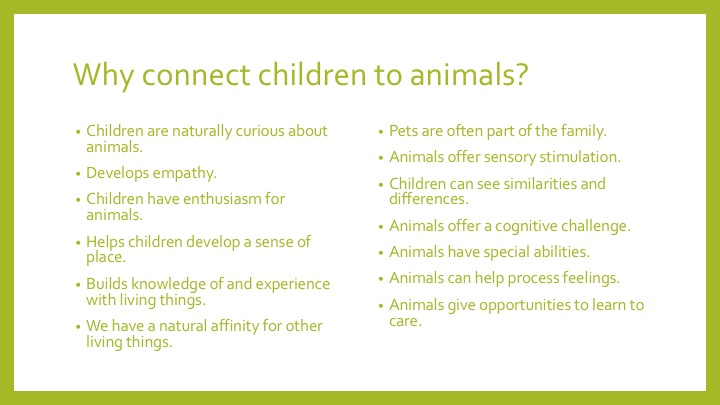
Connecting Children to Animals


Some ideas from Patty Born Selly (aff link) 


NSTAPosition Statement on Responsible Use of Live Animals and Dissection in the Science Classroom


Certified Wildlife Habitat:


Blogpost and Podcast—Loose Parts Nature Play Animal Play episode


Apps—Merlin Bird ID
Facebook Groups—IN Nature, Birding in Indiana, ICAN Learn Outdoors, Indiana Wildlife Photography, Insect Identification, Hoosier Herpetological Society


Article:
Scaly, Slimy Fun in Prekindergarten


Quote:
Cultivating relationships with animals, both real and imagined, is one of the best ways to foster empathy during early childhood. Children want to run like deer, to slither along the ground like snakes, to be clever as a fox and quick like a bunny. There's no need for endangered species here – there are more than enough common, everyday species to fill the lives of children. And the environmentally correct notion of not anthropomorphizing animals can be thrown out the window. 
  David Sobel


Identiflier (aff link)


Monday, August 22, 2016

Deer Dancer: A Book Review and Resources


Deer Dancer by Mary Lyn Ray is a delightful look at the interaction and play between a young child who is in dance and a deer. You can find it read online here. It is a simple, easy to read book which would be appropriate for preschoolers or younger grade school. I really liked the movement, imagination, and the connection of dance to nature. Personally, I typically do programs on deer in the fall. I would include this quick book as part of a creative movement feature, reading the book, and then having music for a deer dance. There is a native story that this reminds me of deer dancing like this. I might also share this book as part of our exploration on deer. Here is a listing of various native stories on deer. Here is a link on a Yaqui Deer Dance as well and another with a video.

The story reads:
There’s a place I go that’s green and grass,
a place I thought that no one knew—
until the deer came.

I love that this recognizes and validates those special places for children. We tend to watch our children pretty vigilantly as a society, but allowing a nearby secret space or even just a hidden space nearby where we can hear what is going on is magical. Additionally, there is much imagery, as she is still as the grass. I really like the natural connection. 

The girl is somewhat apprehensive with her skills as a dancer; however, her confidence grew as she lifted her antlers like the deer. 


I love seeing children explore animals through play. Dance is a form of play. Here are other ideas I have pulled together to help children learn about animals through play:

Additionally, I often teach about deer in nature preschool. Here are ideas that we used to connect to deer.

General information on White Tailed Deer in Spring:


This post may contain affiliate links. I found it at the Bristol Library. 

Friday, January 1, 2016

Under Ground: A Book Review


I've always loved Denise Fleming's books about nature for preschoolers. The pages are very engaging and have simple text that helps understand the content. In underGROUND, Fleming continues her winning style. Guess what? She just lives over in Toledo, OH--that's only about 2 hours away, so she is enjoying similar nature to what we find close. Find her at her website. She has some related activities for the book on the site. She also shows how she makes pulp paper. I've tried this before and it's a little harder than it looks! :-) I like how she uses stencils to get the pulp to go where she wants it. 

Beaks! A Book Review


Beaks!, by Sneed B. Collard III, is a neat look at bird adaptations, looking specifically at beaks and how birds use them in a variety of ways. I like how the book starts out, reminding us that a beak is something that really makes a bird unique, when it has no feet, hands, antlers, horns, or spines. 

Burrows, Nests & Lairs: A Book Review


Burrows, Nests & Lairs: Animal Architects by Lark Books is a neat way to see how animals use natural elements around them to build! I've done presentations on Animal Homes in the past and this brings much of the good information from the presentation in one place for an intermediate reader. The book mentions that animals are built for survival and don't need "homes" like we as humans do; however, in order to raise their young or stay safe from predation or weather, animals will build structures to enhance survival. Animals are born with the instinct to build and the tools to do it. Made from sand, mud, grasses, and sticks, animals can make amazing structures! 

Monday, November 2, 2015

Under the Snow: A Book Review

I am always on the lookout for good books about animals in winter, as it's a favorite topic to teach about! I found Under the Snow at our local library in Bristol. Please don't check it out in December-February, because I think I will need it! :-)

I've read several other books on the topic that have potential; however, they often fall short. This book delivered in important elements for me!

Wednesday, April 15, 2015

Planting the Wild Garden: A book review

Planting the Wild Garden by Kathryn O. Galbraith was delightful! Wendy Anderson Halperin added to the story through her illustrations. While the book didn't focus on specific wildflowers, it showed that many animals and other natural forces help "plant" wild gardens. This is a basic look at seed dispersal. The illustrations are lovely--I like seeing all the different types of seeds inside the front and back covers. The story starts with a farmer and boy planting seeds in a  garden. Illustrations of the process of the new seed growing toward a plant that can be eaten are shown along the outside edge of the main picture.

The reader then is guided through other ways seeds are "planted", such as wind dispersion. The illustrations show the wind scattering the seeds. Sound words are included which make for a great read aloud book. Even the text is whimsically patterned like the wind on this page. Small details like this make a difference.

The goldfinch is used to illustrate how "droppings" can help in seed dispersal as well. Lots of great thistle drawings. Sound words are included once again. Little information is given on this section that briefly looks at scat (poop) as a way of seed dispersal. This keeps with the dignity of the book; however, I like using that gross factor to get children's attention.

The Scotch broom plant (invasive in the western US) is used to show how some seed pods POP! Fun illustrations show that progression. Personally, I love jewelweed locally, one of the touch me nots. This is such a fun little plant that makes me happy!

Rain is also a way that seeds are moved from one place to another. Plip-plop! Love how the gray lines show the rain in this illustration. Moving beyond the rain, a stream is shown as another dispersal technique with some making it to the banks to grow the next year.

A few animals are also part of this dispersal process, looking at a rabbit started by a fox and spreading seeds in the process. Seeds also attach on her fur, with a mention of cockleburs and creeping through Queen Anne's lace (also came from Europe). I like that they mention how they "hook" onto the fur. Raccoons also feast on blackberries and bring seeds with them. Squirrels bury acorns to store for the winter, yet often become trees if not found again. The author even looks at us as humans and how seeds catch on our socks and pants and muddy boots. We also love blowing seeds and helping with wind dispersal.

The author ends with "Seed by seed, we planted this wild meadow garden. Wind and water. Birds and animals. Plants and people. All of us. Together." A bibliography of additional resources is included at the end.

I really liked this book that looks at seed dispersal! It's great for preschoolers and could be used for elementary school as well, using it to set the stage and then talk in more depth of various seed dispersal methods.

There could be many extensions to use with this book, such as the classic activity of putting an old sock over a leg and going for a hike to collect seeds. This can then be planted to see what "grows" from the walk. One year, my son didn't want to put the sock on his leg, so we made it into a little animal puppet that scampered through the meadow. This could be another way to include imaginative play as well. Additionally, I like to collect milk weed pods (with seeds) and cattails to experience wind dispersal of seeds with preschool and young elementary school children. It's a joy to watch them with the seeds, similar to the mesmerizing effects of chasing bubbles. We've been trying to gather and plant our milkweed seeds around the perimeters of our yard, hoping for more this next year.
This Classroom Bookshelf website share various activities and extensions for use with the book. Great ideas! Additional activities can be found on the Growing with Science blog. This is a starting point to discover seed dispersal. Personally, I'd like to look at how ants disperse seeds more, which isn't included in the book. However, the book renews my interest and is a great way to share with young children. The sounds and action words help make it a good read aloud.


This post may contain affiliate links. I can find this book locally at the Bristol library.


Friday, April 3, 2015

Exploring Spring at our Local Garden Store

We stopped by our local garden megacomplex, Linton's Enchanted Gardens, for a special Easter Eggstravaganza recently. We were welcomed with a Spring banner as well as fun decorations. They do a great job with seasonal decor! We've been here for past special days like this, as well as just stopping by to explore with the 2-year-old. See some of our other Easter ideas connected to nature here, including links to a past Easter Eggstravaganza.

We typically check out the fish first. There is a newish cafe near the indoor pond. I will say there is "nature" throughout the store. While the store focuses on gardening, they also have clothing, decor, jewelry, games, rocks, and so much more. There is also a large variety of prices, making it easy to find something for most budgets. I could find plenty of items to buy. At Christmas, a book club I attend had a local store gift card exchange and I purchased a gift card for Lintons'. It could be used on so many things, including food! 


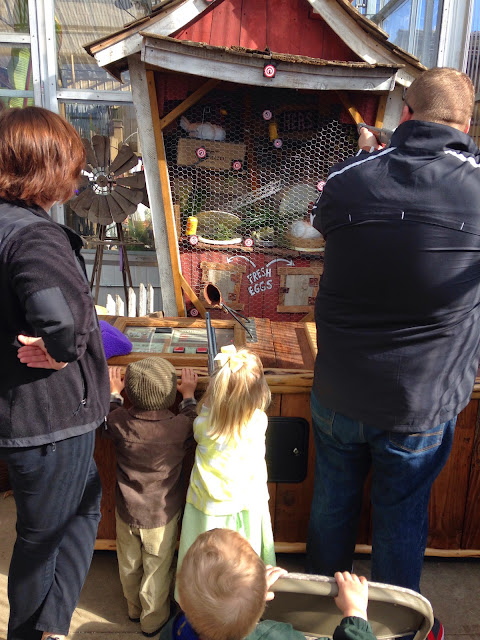
After exploring inside, we went out to the patio/greenhouse areas, visiting the rabbits and Bloomer, the resident macaw. What a fun bird! For my two-year-old this is a great place to explore!


We gave high fives to the Easter bunny. They were collecting food pantry donations for a picture with the bunny, which is a neat way to help give back to the community and add another attraction. For these special days, they have additional attractions, like ducklings, chicks, and other young animals to look at that rebirth of life. I'm sure visiting it again just a week later would show the growth at least in the young birds, if not the other animals. 


There were also kids or baby goats, though my nephew seemed intrigued by the pig nearby.


There were sheep and a calf also. Made me miss our Bessie! 


Near the chicks, my youngest thought these "chicks" for sale were a perfect sensory bin. He's used to playing with things in bins like this through nature preschool at Woodlawn Nature Center. Linton's has a duckling slide set up, but they seemed a little wary to go down it. Maybe they are pros at it by now. 


Linton's also offers classes on a regular basis. I've been to one or two in the past and found them helpful for the topics. It's a nice way to learn. Here is a post from a Natural Holiday. Find their schedule of classes here


I noticed there was a shooting game you can pay for. My nephew just liked playing with the gun, though the rabbit was fun as well. 


The kids love the treehouse! It was fun walking through the outside area and getting in a little play time.


I always love seeing signs like this Certified Wildlife Habitat. While we don't have to go through the formal certification process, enhancing our properties to allow food, water, cover, and places to raise young is always helpful for our natural world. Here is information on how to do that. At our house, we're still working on the water; however, there are many lakes and ponds nearby as well. 

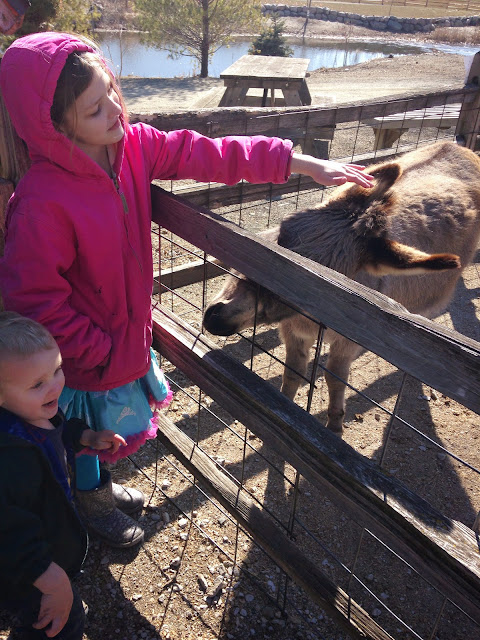
We grabbed some feed nearby for a quarter and fed the goats, pigs, and other animals. It's nice to have animals to see up close sometimes and to see the differences with domesticated and wild animals.


In the petting zoo, we also were able to see a donkey up close. Since this was part of our Easter celebration, we talked about the donkey and the cross on its back. 


It's neat to see the different birds near the petting zoo. We heard a turkey, saw the peacocks, and looked at many other interesting birds. Many families chose to pay a fee to take the train out to an egg hunt. My youngest was mesmerized by the train and it looked like they all had fun. We've gone to their free hunts in the past. 


The tori gate always reminds me of our time in Japan. There are whimsical structures like this throughout out the gardens. The UFO is another interesting treat. Playing with shadows is fun anywhere! My youngest and I have been playing a sort of shadow tag recently where we "tag" the other by making their shadow disappear in the shadow of the other. I guess I always win that one since my shadow is bigger!


We had to stop for another petting of the bunny! Having special moments to get close to calm animals like this is intriguing for children. My youngest was enchanted by the fairy garden miniatures. He thought all the animals should go in the barn. I'm trying to think of ways to capture that enchantment in a safe way for younger and older children to "play" with options like this in a public fairy garden. 


We're sharing this with the Outdoor Play Party. Spending time at your local garden center can be a fun way to connect with nature! We had a fun time and only spent about 50 cents on food at the petting zoo, though there are many options to spend money if desired, such as food, the egg hunt and train ride, and all the beautiful stuff they have inside. I like that there are options--it can be less expensive or a place to buy things if desired. It's great to support local businesses like this so I know I can stop by and pick up a gift, snack, or needed garden supplies.